
Unlocking the Potential of Stretch Mesh Fabric for the Garment Industry
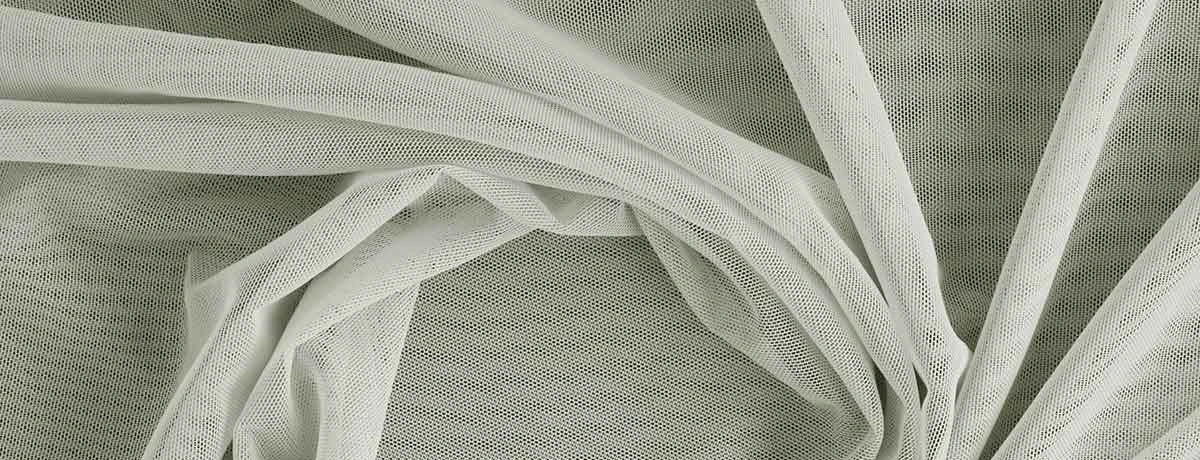
Stretch mesh fabric is an open-knit textile blended with an elastane fiber (spandex or Lycra) so the mesh recovers after stretching. The base is usually nylon or polyester for structure, and the spandex content, typically 10–25%, sets how far it stretches and how well it snaps back.
Key Takeaways
- Stretch mesh is an open-knit mesh + elastane blend; nylon or polyester gives structure, spandex gives the stretch.
- 2-way vs 4-way stretch is the first spec to lock: 4-way (stretch in both directions) is standard for activewear and shapewear.
- Power mesh is a firmer, higher-spandex stretch mesh used for compression and lingerie support panels.
- For B2B orders, specify fiber base, spandex %, stretch direction, GSM, and width, not just “stretch mesh”.
What Does Stretch Mesh Fabric Mean? (Definition)
Stretch mesh fabric is a lightweight, open-hole knit made by blending a base yarn such as nylon or polyester with elastane fibers like spandex or Lycra, which gives the fabric breathability, sheerness, stretch, and the ability to recover after extension. The open structure is what makes it breathable and sheer; the elastane content is what separates it from a rigid mesh or standard net. Change the spandex percentage and you change the compression, the recovery, and the price, but the open-knit hand stays the same.
For wholesalers, garment manufacturers, sourcing buyers, and other apparel professionals, that distinction matters on the spec sheet. A 15% spandex tricot mesh behaves nothing like a 5% "slight stretch" net, even though a catalog might list both as "stretch mesh." This guide breaks down the fabric’s composition, the common base-fiber types, 2-way versus 4-way stretch, how stretch mesh differs from power mesh, the key performance properties, where it is used across garment categories, and what to check when sourcing so you can match the right material to activewear, shapewear, lingerie, eveningwear, and other margin-sensitive products.
What Are the Main Types of Stretch Mesh? (Fiber Base)
Beyond knits, MH also supplies four-way polyester spandex stretch woven fabric for buyers who need similar stretch and recovery in non-mesh applications.
Stretch mesh is defined by its base fiber as much as its knit. Each base changes hand-feel, durability, and cost, and each suits a different end use. Here are the bases most likely to appear on a spec sheet:
| Fiber base | Typical hand & properties | Common B2B uses | Relative cost |
|---|---|---|---|
| Nylon / spandex | Soft, strong, excellent recovery | Lingerie, sportswear, shapewear | Mid |
| Polyester / spandex | Durable, easy-care, holds print | Activewear, linings, printed mesh | Low–Mid |
| Recycled polyester / spandex | Same hand as virgin PET, eco-positioned | Sustainable activewear lines | Mid |
| Poly / cotton blend mesh | Softer, more breathable, less stretch | Casualwear inserts, overlays | Low–Mid |
-
Nylon spandex mesh gives the best strength-to-weight and recovery, which is why it dominates lingerie and sportswear, while more rigid options like polyester stiff net fabric serve structured trims and millinery needs.
-
Polyester spandex mesh takes print well and resists snags, useful for printed stretch mesh and decorative overlays.
-
Soft net variants like a 100% polyester soft net trade some stretch for a gentler hand on sheer accents.
What Is the Difference Between 2-Way and 4-Way Stretch Mesh?
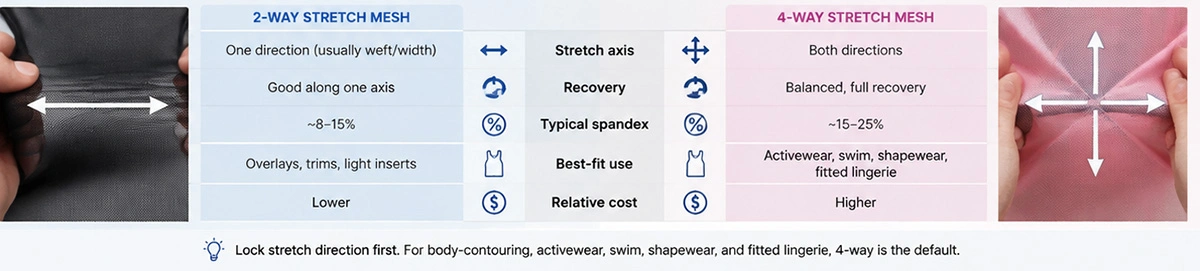
The first spec to lock before quoting is stretch direction. 2-way stretch mesh stretches across one axis (usually the width); 4-way stretch mesh stretches and recovers in both length and width. For anything body-contouring, activewear, swim, shapewear, or fitted lingerie, 4-way is the default, because it moves with the wearer instead of resisting in one direction.
Power Mesh vs Stretch Mesh: What's the Difference?
Buyers often use "power mesh" and "stretch mesh" interchangeably, but they are not the same spec. Power mesh is a firmer, denser, higher-spandex stretch mesh engineered for compression and support, think shapewear panels, bra wings, and sports-bra lining. Standard stretch mesh is softer and more open, used where breathability and drape matter more than hold.
| Stretch mesh | Power mesh | |
|---|---|---|
| Feel | Soft, open, sheer | Firm, dense, resistant |
| Function | Breathability, drape, sheer accent | Compression, shaping, support |
| Typical spandex | ~10–20% | ~20–30% |
| Common use | Activewear, lingerie, overlays | Shapewear, bra panels, medical support |
When a spec sheet asks for "support" or "compression," it almost always means power mesh. Quoting a soft stretch mesh against a compression requirement is the most common return we see on this category, so it's worth confirming which one the end garment needs.
What Are the Key Properties of Stretch Mesh?
Stretch mesh earns its place in a catalog on four properties buyers can rely on: stretch and recovery from the elastane content, breathability from the open-knit holes, low weight for next-to-skin comfort, and enough durability to survive repeated stretch-and-wash cycles. The open structure promotes airflow, which is why it shows up in activewear and warm-climate garments; the spandex is what lets it hold shape order after order.
-
Stretch and recovery — the spandex content sets both; higher % means more compression and snap-back.
-
Breathability — open holes promote airflow, ideal for activewear and linings.
-
Lightweight, low-friction hand — comfortable next to skin for lingerie and undergarments.
-
Durability — quality 4-way constructions resist wear from stretching, washing, and activity.
Where Is Stretch Mesh Used? (Applications)
Stretch mesh spans several garment categories because one base construction serves both function and fashion. In apparel, the same open-knit that ventilates a running top also creates a sheer overlay on an evening gown. For a sourcing buyer, the useful insight is that a single spandex mesh base can serve activewear, lingerie, and home uses at once, which consolidates orders and improves per-meter pricing when buying by the yard.
Beyond garments, mesh also works in home projects such as ergonomic office furniture where breathable support matters.
-
Activewear and sportswear — leggings, sports bras, jerseys, and compression tops use 4-way stretch mesh for moisture management, lightweight activewear, and full range of motion.
-
Lingerie and intimates — soft nylon spandex mesh gives form-fitting comfort; power mesh handles support panels.
-
Eveningwear and gowns — sheer black stretch mesh adds lightness and a delicate, elegant face to high-fashion pieces, and can also serve as decorative accents in layered designs.
-
Costumes and dancewear — durable polyester mesh holds shape while allowing freedom of motion, while 100% polyester Dri-Fit fabric covers solid panels that need quick-drying performance.
-
Casualwear and accessories — printed stretch mesh works for inserts, overlays, and breathable accessory panels, making it useful for sewing projects and practical crafts, and can be paired with wholesale chiffon fabric for dresses and overlays in the same collection.
Sourcing Stretch Mesh Fabric from MH (Supplier Overview)
MH (Ningbo MH), established in 1999, is a China-based garment-materials supplier serving buyers in 150+ countries, with nine factories, 3,000+ workers, and 2,000+ partner manufacturers offering around 10,000 materials and fabrics. For a stretch mesh buyer, that scale means three things:
- Consistent lots — nylon and polyester spandex mesh woven to repeatable stretch, recovery, and weight across reorders, so buyers can continue to reorder against the same targets.
- One-stop materials — pair mesh with wholesale sewing threads for large-scale production, customized polyester sewing threads, matching elastic, lace, and tape from one source.
- Spec-based quoting — order against fiber base, spandex %, stretch direction, GSM, width, MOQ, and lead time, so you compare like-for-like.
MH’s broader textile manufacturing capabilities across fabrics and accessories and its role as a leading global provider of garment accessories and tailoring materials mean buyers can consolidate sourcing, from specialty threads like 150D/2 rayon embroidery thread to 50/2 polyester core-spun sewing thread for fashion and outdoor garments.
Browse the mesh fabric range →

Frequently Asked Questions
What is stretch mesh fabric made of?
Stretch mesh is an open-knit fabric that blends a base yarn, usually nylon or polyester, with an elastane fiber like spandex or Lycra. The base gives structure and the elastane gives stretch and recovery. Spandex content typically runs 10–25%, which is what sets the compression and snap-back on a purchase order.
What spandex percentage should I specify for activewear?
For 4-way stretch activewear, a spandex content around 15–25% gives the balance of stretch and recovery most performance garments need. Lower percentages suit overlays and light inserts; higher percentages move toward power mesh for compression. Always confirm against the target garment and test recovery on a sample.
What information do I need to order stretch mesh from a supplier?
Specify the fiber base (nylon/polyester), spandex percentage, stretch direction (2-way or 4-way), weight in GSM, finished width, finish, color, MOQ, and lead time. Providing these upfront lets a supplier like MH quote accurately and hold consistent lots across reorders.
Conclusion
Stretch mesh's value comes from one flexible construction, an open knit plus an elastane blend, that spans performance activewear, supportive shapewear, and sheer eveningwear from a single fabric family. Get the spec right and pair it with a supplier that can hold consistency at volume, and stretch mesh becomes one of the most versatile, margin-friendly materials in your catalog.
