
Nonwoven Industry Insights: Trends, Challenges & Future Outlook

Nonwoven fabric is a web of fibers bonded directly by heat, chemicals, water jets, or needles, with no spinning or weaving involved. That single difference is why it costs less per meter than woven cloth and why a purchase order can't just say "nonwoven": the same word covers a 15 gsm mask filter and a 150 gsm car-trunk liner. To buy it correctly, you specify three things together: the process (spunbond, spunlace, or meltblown), the polymer (usually polypropylene or polyester), and the weight in gsm.
Key Takeaways
- Nonwoven is defined by bonding, not weaving; spec it by process + polymer + GSM, never by name alone.
- Spunbond is the low-cost workhorse (10–150 gsm), spunlace is the soft one for wipes and interlining, meltblown is the fine-fiber filter layer (15–25 gsm).
- Polypropylene dominates disposables; polyester wins where heat resistance and durability matter.
- SMS (spunbond-meltblown-spunbond) is the standard construction for masks, gowns, and protective apparel.
What Are Nonwoven Fabrics?
The nonwoven industry produces them by forming and bonding fibers directly—without weaving or knitting—into cost-effective materials for medical, hygiene, garment, automotive, agriculture, packaging, and industrial use. Loose fibres, either continuous filaments or short staple fibers, go through web formation before being bonded in place, and they can be produced from a wide range of natural and synthetic raw materials.
Properties are engineered rather than inherited from a weave. Absorbency, liquid repellence, resilience, strength, and barrier performance can each be dialed in through fiber choice, bonding method, and finishing treatment.
Because there's no weaving loom or knitting machine in the chain, the nonwoven industry is valued for speed of production and cost-effectiveness, which is exactly why nonwovens took over disposables, interlinings, and industrial liners. The same production model now underpins spunbond, spunlace, and meltblown materials used in protective apparel, personal care, filtration, and other high-volume products, making the category increasingly important as healthcare demand and sustainability requirements reshape sourcing and manufacturing decisions.
Spunbond vs Spunlace vs Meltblown: Which Type Do You Need in the Nonwovens Industry?
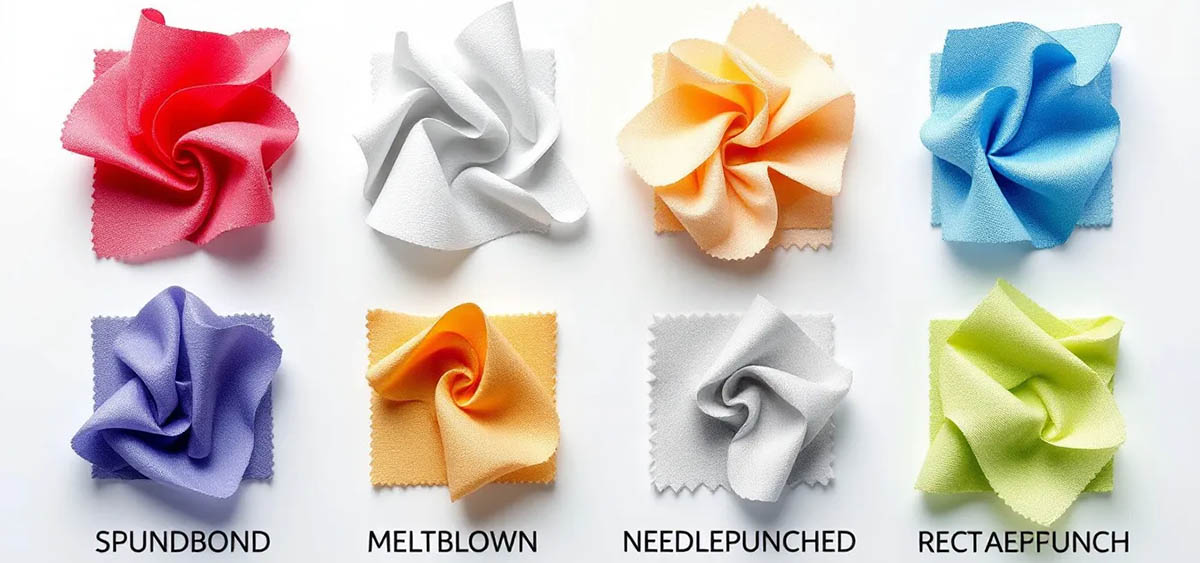
The three commercial workhorses are spunbond, spunlace, and meltblown, and they aren't interchangeable. Spunbond gives you strength at the lowest cost, spunlace gives you softness and absorbency, and meltblown gives you filtration. Most sourcing mistakes we see trace back to quoting one type against another as if they were equivalent.
| Spunbond | Spunlace | Meltblown | |
|---|---|---|---|
| How it's made | Continuous filaments spun and thermally bonded into a web | Staple fibers entangled by high-pressure water jets | Molten polymer blown into ultra-fine fibers |
| Hand feel | Crisp, paper-like | Soft, textile-like | Delicate, fluffy |
| Key strength | Tensile strength at low cost | Softness + absorbency | Fine-fiber filtration barrier |
| Typical GSM | 10–150 gsm | 30–80 gsm | 15–25 gsm |
| Common B2B uses | Shopping bags, packaging, agriculture covers, hygiene backsheets | Wet wipes, cosmetic pads, medical drapes, garment interlining | Mask filter layers, protective apparel, industrial filters |
| Relative cost | Low | Mid | Mid–High (spec-dependent) |
Spunbond Nonwovens
Spunbond is the volume product. Produced in one continuous process line, it is widely used by nonwovens manufacturers for cost efficiency. Filaments are extruded, laid, and bonded in one continuous line, so it's the cheapest nonwoven to make and the one you'll quote most often for bags, packaging, furniture lining, and hygiene components, then wound into rolls for converting after bonding. A 60 gsm recycled polypropylene spunbond is a typical bag-and-packaging weight; hygiene applications run much lighter, often 10–25 gsm.
Spunlace Nonwovens
Spunlace trades some cost for a genuinely textile hand. High-pressure water jets mechanically entangle the fibers for mechanical bonding with no chemical binder, which makes spunlace ideal for skin-contact products and is why it ends up in wet wipes, cosmetic pads, medical drapes, and garment interlining. That versatility also makes it useful across wipes, medical, and interlining uses. It's highly absorbent, drapes well, and can blend viscose or cotton into the mix for extra softness, with different fibres combined for skin-contact products.
Meltblown Nonwovens
Meltblown is the filtration layer, delivering strong filtration performance even though the web is fragile on its own. Blowing molten polymer through fine-hole spinnerets, with production setups that can use up to 40 holes per inch, produces microfibers far thinner than spunbond filaments, creating ultrafine fibers that capture particles. On its own it's fragile, so spunbond and melt-blown layers are combined to create SMS (spunbond-meltblown-spunbond) multifunctional barrier materials; a 15 gsm SMS meltblown-spunbond material or a 20 gsm disposable SMS spunbond is the standard construction for masks, gowns, and protective apparel. Pure PP meltblown is also sold as a filter media on its own for filtration and healthcare sector uses.
Which Raw Material Should You Specify?
Polypropylene (PP) is the default for disposables and polyester (PET) is the default for durability. Natural and cellulosic fibers, mainly viscose, cotton, and wood pulp, come in when softness, absorbency, or biodegradability is part of the product claim. The polymer line on your PO drives price, performance, compliance, and the importance of material disclosure all at once across the synthetic side of the market.
| Fiber base | Why buyers pick it | Watch out for |
|---|---|---|
| Polypropylene (PP) | Lowest cost, moisture-resistant, good chemical resistance; the disposables standard | Melts at relatively low heat; UV degrades it without stabilizer |
| Polyester (PET) | Higher strength and heat resistance; holds up in durable applications, including automotive components and durable geotextiles | Costs more than PP |
| Viscose / cotton | Soft, absorbent, skin-friendly; common in spunlace wipes | Higher cost; wet strength needs checking |
| Wood pulp | Excellent absorbency at low cost (airlaid cores) | Low strength alone; usually blended |
Both PP and PET track oil-linked resin pricing, so nonwoven prices move with the resin market, and volatility in polypropylene can also squeeze profit margins. The push for sustainability is also shifting buyers toward recycled and bio-based feedstocks and sustainable nonwovens, including biodegradable nonwoven materials, even though recycling remains technically and economically difficult because mixed-material products are hard to process.
Where Are Nonwovens Used? (Applications by Buyer Segment, Including the Healthcare Sector)
Nonwovens sell into nearly every sourcing category MH's buyers work in:
-
Medical and hygiene: surgical gowns, masks, drapes, wound care, diaper components. SMS constructions provide the liquid and bacterial barrier; meltblown provides filtration, and healthcare sector demand has increased rapidly post-COVID-19.
-
Personal care: wet wipes and cosmetic pads, mostly spunlace for its softness and absorbency; sustainable nonwoven materials are increasingly in demand as brands replace single use plastics with eco-friendly alternatives, and this also includes personal care products alongside lightweight chiffon fabrics for fashion and linings. The nonwoven industry is seeing dynamic shifts driven by sustainable practices, with demand for eco-friendly products up 15% in 2024. In Europe, the European Union's Green Deal is also promoting eco-friendly nonwovens.
-
Garment manufacturing: nonwoven interlining fabric is the quiet volume item here, fusible or sew-in, typically 20–100 gsm depending on the garment zone.
-
Home textiles and furniture: mattress and sofa lining, dust covers, upholstery backing.
-
Automotive: trunk liners, sound insulation, trim backing, where light weight per m² matters and nonwoven fabrics can be 15%-20% lighter than competing materials, fitting into MH's broader textile manufacturing capabilities for home textiles and technical applications.
-
Agriculture and packaging: crop covers, plant protection, and spunbond shopping bags, sometimes used together with durable fishing twine for tying and support.
Asia-Pacific is expected to dominate the nonwoven fabrics market, and expanding regional production hubs are gaining share across key industrial applications.
Many of these applications use laminated nonwovens, where a film or second layer is bonded on for waterproofing or strength, often combined with PE + SPP coated non-woven fabric for disposable protective clothing, and in production the web must also be evenly spread. Some grades also start from patterned films to create specific structures while combining a barrier with a soft face in a single material.
Sourcing Nonwoven Fabric from MH: Insights into the Nonwoven Fabrics Market
Nonwovens rarely travel alone on a bill of materials. A garment factory ordering fusible interlining also needs the thread, zippers, and tape for the same production run; a hygiene or medical buyer needs the same GSM and hand feel arriving batch after batch, which is why many turn to a leading provider of garment accessories and tailoring materials.
That combination, breadth plus repeatability, is what MH (Ningbo MH) has built since 1999 under its "Kingdom of Sewing" banner: with nine factories on roughly 350,000 m², more than 3,000 workers, 2,000+ partner manufacturers, and a catalog of around 10,000 tailoring materials and fabrics, including dedicated wholesale sewing threads for industrial production, so spunbond, spunlace, and SMS materials ship together with everything else your line consumes for customers.
Quotes are built from your specification (fiber, GSM, width, finish, MOQ, lead time), and reorders are held to it, supported by MH's 40/2 100% spun polyester sewing thread factory for consistent garment assembly. More on choosing a nonwoven fabric supplier, or contact MH with your spec sheet for a quotation.


Frequently Asked Questions
What's the difference between nonwoven and woven fabric?
Woven fabric interlaces yarns on a loom; nonwoven bonds loose fibers directly with heat, water jets, chemicals, or needles. Skipping the yarn stage makes nonwovens faster and cheaper to produce, which is why they dominate disposables, interlinings, and industrial liners, while wovens keep the edge in durability and drape.
Which nonwoven type is best for wet wipes?
Spunlace. Water-jet entanglement gives it a soft, textile-like hand with high absorbency and no chemical binder, all of which matter for skin contact. Typical wipe substrates run 30–80 gsm, often blending viscose with polyester or PP for extra softness.
What does GSM mean when buying nonwoven fabric?
GSM is grams per square meter, the standard measure of a nonwoven's weight and the main driver of its price. Hygiene spunbond runs light (10–25 gsm), bags and packaging sit around 50–90 gsm, and garment interlinings span 20–100 gsm depending on the garment zone.
What is SMS nonwoven fabric?
SMS stands for spunbond-meltblown-spunbond: a meltblown filtration layer sandwiched between two spunbond layers for strength. It's the standard construction for surgical masks, gowns, and protective apparel, commonly 15–25 gsm depending on the application.
What is nonwoven interlining?
Nonwoven interlining is a bonded fiber fabric, fusible or sew-in, placed inside collars, cuffs, plackets, and waistbands to add structure. It typically runs 20–100 gsm and costs less than woven interlining, which is why it's the volume choice in garment manufacturing and is frequently combined with 150D/2 rayon embroidery thread for branding and decoration.
